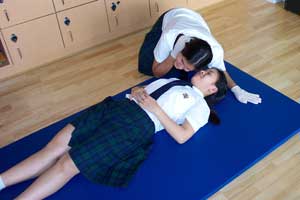
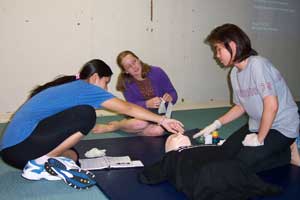
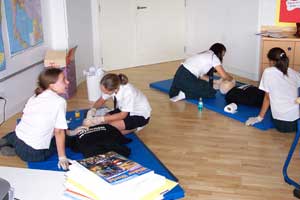
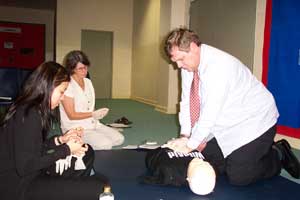
The Emergency First Response Primary Care (CPR) and
Emergency First Response Secondary Care (First Aid)
courses teach people how to provide emergency care for
someone in need. These courses make learning easy by
providing a non-stressful environment in which
participants practice and apply emergency care skills.
The courses are designed to: 1) help participants
remember appropriate emergency care procedures during
times of need, and 2) encourage them to apply those
procedures by assisting those needing emergency care.
Emergency First Response Primary and Secondary Care
courses are based on internationally recognized medical
guidelines for emergency care, guidelines produced
through a consensus process of practicing professionals
in the emergency medical field. Educationally, the
courses reflect a well-researched instructional design
for this type of training.
The
two courses, Emergency First Response Primary Care (CPR)
and Emergency First Response Secondary Care (First Aid),
make up a foundational offering in emergency care for
the lay provider. Within the two courses, CPR and first
aid skills are integrated into an easy-to-remember
emergency care sequence. This sequence allows
participants to provide effective emergency care to
injured or ill persons.
Because of the sequence of skills and information,
participants must complete the Emergency First Response
Primary Care (CPR) course (or other qualifying course)
before beginning the Emergency First Response Secondary
Care (First Aid) course. Participant material is the
same for both courses.
Emergency First Response Primary Care. (CPR)
Emergency First Response Primary Care (CPR) teaches
you how to deal with emergencies that
are immediately life
threatening. You will focus on primary care through
a combination of knowledge development, skill
development and realistic scenario practice to make
sure you have the knowledge, understanding and
confidence to use your skills.
Here are the Primary Care (CPR) skills:
-
Scene Assessment
-
Barrier Use
-
Primary Assessment
-
Rescue Breathing
-
Cardiopulmonary Resuscitation (CPR)
-
Serious bleeding management
-
Shock management
-
Spinal injury management
-
You may also participate in an Automated
External Defibrillator (AED) training component,
learn how to help a conscious choking adult and
have an emergency oxygen use orientation.
Secondary Care (first aid)
Secondary Care (first aid) covers injuries or
illnesses that are not immediately life threatening
or when local EMS is unavailable or delayed. You
focus on secondary assessment and first aid through
knowledge development, skill development and
realistic scenario practice. The Secondary Care
(first aid) skills are:
Course Length
Primary Care (CPR) 4+ hours of Instruction
Secondary Care (First Aid) 3+ Hours of Instruction